
Customer Service Ticket Systems: Enabling Scalable and Structured Global Support
Today, when globalization and multi-channel services have become the norm, Customer Service Ticket has become the basic capability of the enterprise customer support system.
For enterprises serving overseas markets, customer requests no longer come from a single channel or a single region, but are distributed on multiple platforms, multiple time zones and multiple language environments at the same time. Without a structured management mechanism, customer problems are easily missed, duplicated or delayed, ultimately affecting the overall service experience.

The core value of Customer Service Ticket is to transform fragmented and distributed customer requests into traceable, assignable and analyzable service units, so as to support enterprises to maintain service quality and response efficiency under large-scale operations.
I. What is a Customer Service Ticket?
The structured record of customer requests is: Customer ServiceCustomer Service Ticket is a structured record of customer requests.
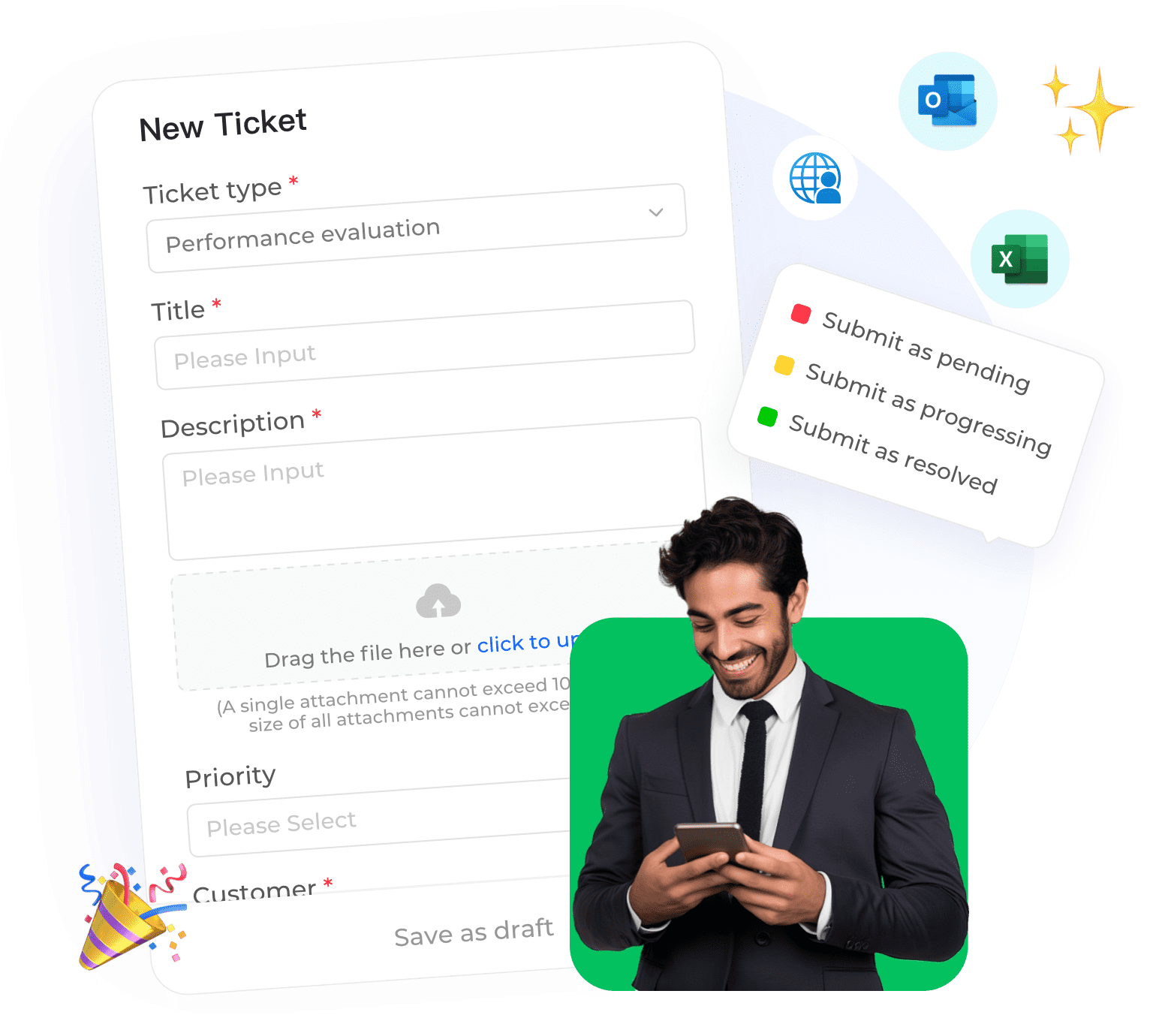
Whether the customer initiates a consultation through email, live chat, social media, website form or app, the system will convert these requests into tickets and record the following key information:
• Customer identity and history
• Type of problem and degree of urgency
• Current processing status
• Responsible service personnel or teams
• Communication records during the service process
Through Customer Service Ticket, enterprises can avoid the service mode of "relying on memory and manual sorting" and make the customer support process more transparent and orderly.
II. Benefits of Customer Service Tickets
1. Preventing Missed or Lost Requests
One of the biggest advantages of Customer Service Ticket is to ensure that every customer request is recorded and followed up.
In a multi-channel environment, without a ticket mechanism, information is very easy to be scattered on different platforms, resulting in omissions or duplicate responses. The Ticket mechanism can ensure that the request has "a source and a place".
2. Improving Response Efficiency
Through automatic allocation and priority management, Customer Service Ticket can help teams identify urgent or high-value issues faster, shorten the overall response time, and improve customer satisfaction.
3. Ensuring Service Consistency
Unified ticket process and processing standards can reduce the fluctuation of service experience caused by personnel differences and help enterprises maintain consistent service standards between different regions and different teams.
4. Supporting Omnichannel Customer Support
Customer Service Ticket centrally manages requests from multiple channels, so that customer service staff can view the complete communication history on the same interface and avoid repeating customer information.
5. Enabling SLA and Priority Management
Through ticket priority and SLA rules, enterprises can allocate resources more scientifically to ensure that key issues are dealt with in a timely manner.
6. Providing Data for Service Optimization
All ticket data will be stored systematically, providing a reliable basis for follow-up analysis of service bottlenecks, customer high-frequency problems and process optimization.
III. Types of Customer Service Tickets
In actual business, different types of customer requests will correspond to different types of Customer Service Ticket:
1. Incident tickets
It is used to deal with sudden problems or service interruptions, such as system abnormalities, unusable functions, etc.
2. Service Request Tickets
It is used for the service needs voluntarily put forward by customers, such as account modification, function opening or information inquiry.
3. Technical support tickets
For complex problems at the technical level, professional teams need to intervene and deal with them.
4. After-sales support tickets
It covers return and exchange, repair, after-sales consultation and other scenarios, which are commonly used in e-commerce and manufacturing industries.
5. Internal Collaboration Tickets
It is used for cross-departmental collaboration and transfer customer problems to relevant internal teams for handling.
6. Priority or SLA-based Tickets
Automatically mark priorities according to the degree of urgency or customer level to ensure the reasonable allocation of resources.
IV. How Customer Service Tickets Work in Practice
A complete Customer Service Ticket usually goes through the following life cycle:
1. Ticket creation (creation)
2. Classification and routing (classification and allocation)
3. Active handling (processing)
4. Resolution and closure
In this process, automated rules, state updates and internal collaboration mechanisms can significantly reduce the cost of manual operations.
V. Automation and Workflow Management
Modern Customer Service Ticket System is not only used to record requests, but also plays the role of process coordination.
By automating the workflow, the system can achieve:
• Automatic allocation of tickets
• Automatic status update
• Automatic reminder and follow-up
• Automatically escalate requests that have not been processed in time
This enables the customer service team to focus on problem solving itself, not process management.
VI. Data Insights from Customer Service Tickets
By analyzing ticket data, enterprises can get:
• Trends of frequently asked questions
• Average processing time
• Peak hours of service
• Changes in customer satisfaction
These data are of great significance for continuously optimizing the service process and training the customer service team.
VII. How Instadesk Ticket System Supports Customer Service Tickets
In multi-channel and cross-regional service scenarios, Instadesk Ticket System provides centralized management capabilities for Customer Service Tickets.
Through a unified ticket management mechanism, enterprises can integrate customer requests from different channels into the same system and realize large-scale service operations through intelligent classification, automatic distribution and process collaboration.
Instadesk Ticket System is not an independent tool, but a key component of the customer service system, supporting end-to-end service management and continuous optimization.
VIII.Why Customer Service Tickets Are Essential for Global Enterprises
For enterprises facing overseas markets, Customer Service Ticket is no longer an optional tool, but an infrastructure.
It helps enterprises maintain stable, efficient and controllable customer support capabilities under the expansion of business scale and increased service complexity.
Conclusion
Customer Service Ticket is the core fulcrum of the modern customer support system.
Through clear classification, traceable processes and data-driven management, enterprises can achieve sustainable service growth in a multi-channel and multi-regional environment.
With solutions such as Instadesk Ticket System, enterprises can transform customer support from passive response to structured, optimizeable long-ter
Share This Article



Issac
Omnichannel Digital Operations: Driving Traffic Growth & Deepening User Value
You may also like

Ticket Association and Linked Issue Management: A Guide for Financial Credit Services
Credit services face complex, interrelated customer issues requiring unified support. Ticket association links related tickets, revealing full context and root causes. Instadesk’s VoiceBot automates linking, history access, and workflows, cutting handle times, boosting satisfaction, and resolving disputes faster.


E-Commerce Customer Support Ticket System: A Guide for Online Retailers
E-commerce customer support faces high volume, complex workflows, and multichannel hurdles. Effective ticket systems unify inquiries, automate workflows, and integrate order data. Instadesk’s solution delivers omnichannel management, AI automation, and self-service portals, proven to boost efficiency, cut response times, and lift customer satisfaction.


Ticket Escalation Management for Enterprise Telecom Operators
Automated ticket escalation management supports telecom operators in meeting SLAs, retaining customers and complying with regulations. It surpasses manual handling, defines four core escalation types, lays out practical implementation steps, and features Instadesk’s platform that cuts SLA breaches by 50% for telecom firms.

Get Started in Minutes. Experience the Difference.




WhatsApp Us Now !